
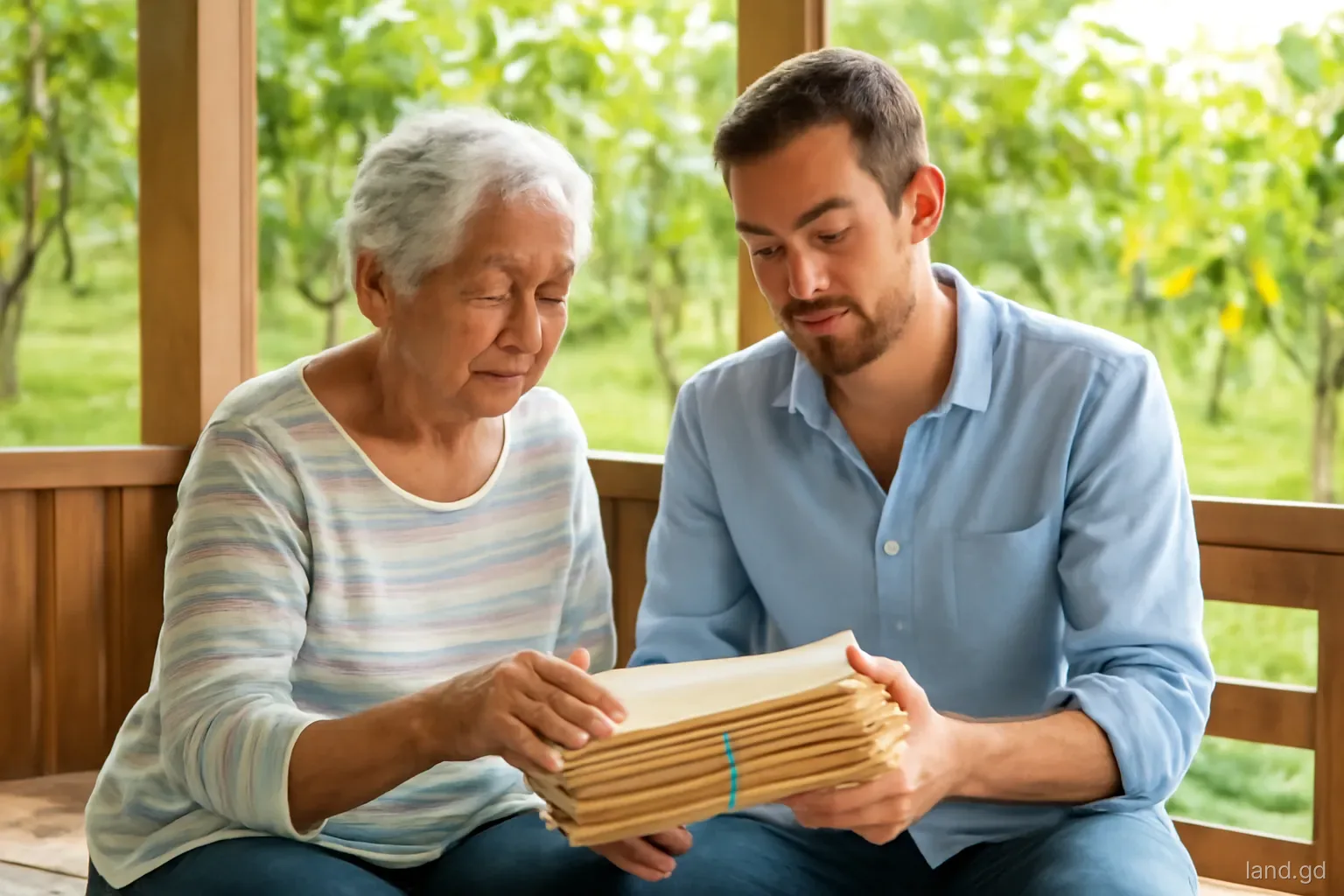
Many Grenadian families keep a folded deed in a biscuit tin or a suitcase under the bed: typed or handwritten, sometimes decades old, often referring to an estate that no longer exists and neighbours long dead. When a sale, a loan, a planning application or a family discussion about inheritance comes up, that paper suddenly matters, and few people can read it confidently.
This guide explains the usual structure of an older Grenadian conveyance or deed of gift, how land was described before modern surveys, the phrases that carry legal weight, and the clues that tell an attorney and a surveyor where to look next. It will help you understand your own papers; for anything that affects ownership, take the deed to a Grenadian attorney.
The anatomy of an older deed
The date and the parties. A deed opens by naming who is giving the land and who is receiving it, with their occupations and places of residence as they were at the time: a planter of a named estate, a seamstress of Gouyave, a labourer of Birch Grove. These details help distinguish people with the same name.
The recitals. Paragraphs beginning with words such as "Whereas" explain how the giver came to own the land: through an earlier purchase, a will or a grant. Recitals point backwards along the chain of title and tell the searcher which earlier deed to find.
The operative words. The heart of the deed is the clause in which the giver conveys, grants or transfers the land, usually stating the price or, for a gift, the natural love and affection behind it.
The parcels clause. The description of the land, often in a schedule at the end, and the part most likely to cause difficulty today.
Reservations and rights. Clauses keeping back something for the seller, such as a right of way, or granting rights to the buyer over other land.
Execution and recording. Signatures, witnesses and the endorsement showing when and where the deed was recorded, often with a volume and page reference.
How land was described before modern surveys
Older Grenadian deeds commonly describe land by its neighbours rather than by measured lines. A typical description might say that the land is a portion of a named estate in the parish of St Andrew, containing by admeasurement two acres, and is bounded on the north by lands of one family, on the south by a public road, on the east by a ravine and on the west by lands formerly of the estate. That told everyone at the time exactly which field was meant. Two or three generations later, with the neighbouring families moved away and the estate broken up, it can be hard to pin down.
Some deeds attach a sketch or refer to a plan by a surveyor, which is a great help if that plan can be traced at the Lands and Surveys Division. Others rely on natural features: a river, a ridge, a mango tree, a stone wall. Rivers shift, trees fall and walls are rebuilt, so the surveyor has to work out where the feature was when the deed was written.
Areas are often given as approximate, with phrases such as "more or less". Combined with old units like roods and perches, that means the stated area is a guide rather than a guarantee. A modern survey is the normal way to turn an old description into a parcel that can be sold, mortgaged or built on.
Phrases worth understanding
Older conveyances use formal language that can sound ornamental but often carries a precise meaning. The ones that matter most:
- "Formerly of" or "now or formerly of": signals that a neighbour's name may already have been out of date when the deed was written. It is a clue for the searcher, not a mistake.
- "Part of" or "portion of" an estate: the land was carved out of a bigger holding. Check whether the portion was ever surveyed and approved separately.
- "Together with" a right of way: the buyer received a right to pass over neighbouring land, often to reach a road. Note its route and width.
- "Subject to" or "excepting and reserving": something was kept back or the land carries a burden, such as a neighbour's right of way or a reservation of a burial plot.
- "For an estate in fee simple" or similar: outright ownership, as opposed to a lease or a life interest.
- "For the term of her natural life": a life interest, meaning someone else, often named, takes the land after that person dies. This changes who owns the land today.
- "Natural love and affection": the usual wording for a gift within a family, with no price paid.
Clues that tell you what to check next
The recording endorsement, often stamped or written on the back or the last page, shows the date of recording and a volume or book reference. If it is missing, the deed may never have been recorded, and that needs attention. If the deed is a copy, ask whether the original is still in the family.
The names in the recitals are the next step backwards. If the deed says the land came to the giver under the will of a parent, the attorney will want to confirm that the will was proved in the High Court. If it says the land was bought from an estate company, the search follows the estate's own title.
A life interest or a joint gift to several children is a sign that ownership may have multiplied since. If a grandmother gave land to her four children jointly and two have since died, their shares may have passed to their own heirs. That is not a reason for alarm, but it shapes who must sign any future sale.
Finally, compare the description with the ground. Walk to the road, the ravine or the wall the deed mentions and see whether the land in the family's use fits.
Common problems with old deeds
Missing pages or schedules. The description is often in a schedule that has been lost. The recorded copy at the Deeds and Land Registry may fill the gap.
Names misspelt or changed. A surname spelt differently from one deed to the next, or a woman recorded under her maiden name, slows a search. Birth, marriage and death certificates help link them.
Land used differently from the deed. Families sometimes occupy a field next to the one the deed describes, or more than it describes. A survey reveals this; a lawyer advises on the consequences.
Gifts never recorded. A parent may have signed a deed of gift that was never lodged. An attorney can advise whether it can still be recorded.
Deceased owner. The last deed is in the name of someone who died years ago. The estate needs to be administered before the land can be dealt with.
Taking the deed to professionals
Bring every paper you have, even ones that look unrelated: earlier deeds, receipts for land tax, old survey plans, wills, death certificates and letters. Families often hold the missing link without knowing it. A Grenadian attorney reviews the documents, runs searches at the Deeds and Land Registry and the High Court Registry, and explains what the chain shows.
A licensed land surveyor then works from the deed, any old plans and the ground to establish the parcel. Where the deed is vague, adjoining owners' deeds and plans help triangulate the boundaries.
Expect the process to take longer for estate land and family land than for a modern lot, and ask both professionals for a clear estimate of steps and fees. Keep originals in your own hands and give professionals copies unless they need the original for recording.
Frequently asked questions
What does "more or less" mean after the acreage?
It signals that the stated area is approximate. Older deeds often relied on rough measurement or estimation. A modern survey gives the actual area, which can differ, and the measured figure is what matters for sale, planning and valuation.
Is a photocopy of an old deed enough to prove ownership?
A copy helps identify the land and the recording reference, but ownership rests on the recorded original and the chain behind it. An attorney can obtain certified copies from the Deeds and Land Registry if the original is lost.
The deed names an estate that no longer exists. Does that matter?
Not in itself. Many Grenadian estates were broken up and sold in portions. The estate name helps locate the land and trace earlier titles. A surveyor uses it, with neighbouring plans, to fix the parcel on the ground.
What is a deed of gift?
A deed transferring land without payment, usually within a family and expressed as made out of natural love and affection. It must be properly executed and recorded like any other deed, and tax or duty treatment may differ from a sale.
Can an old deed be corrected if it contains a mistake?
Errors in names or descriptions can often be dealt with through a corrective deed signed by the parties, or through court proceedings if they cannot sign. An attorney advises on the right route depending on the error and who is still alive.