
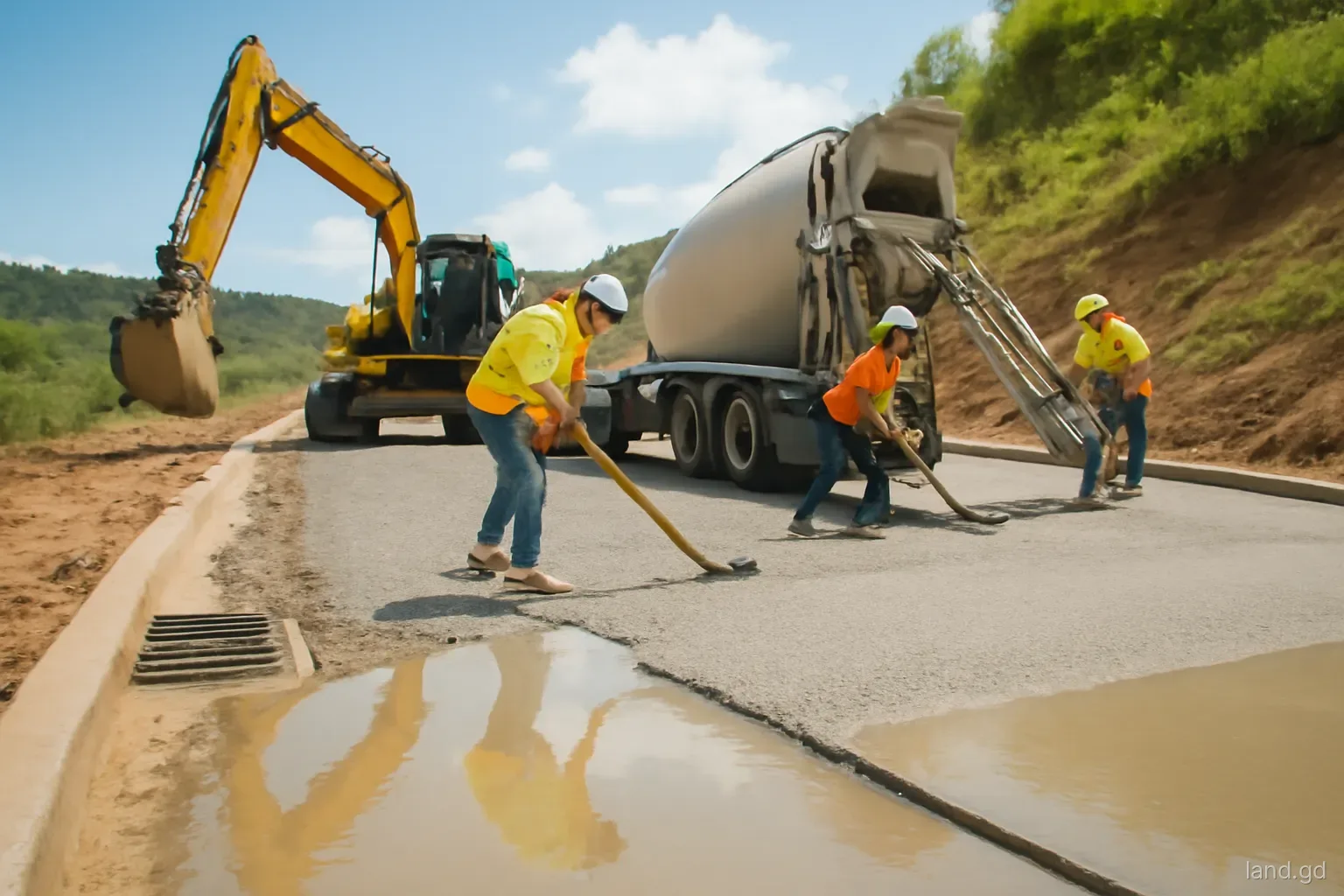
Roads are usually the biggest single cost in a subdivision and the part most likely to go wrong. On Grenada's steep terrain, a road that is cut too steeply, surfaced too thinly or drained badly can wash out in the first heavy rainy season, leaving lots inaccessible and buyers angry. The same road, done properly, makes every lot more valuable and can eventually be handed over to the state to maintain.
This guide covers how subdivision roads are typically designed and built, why drainage matters as much as the surface, what retaining walls and erosion control involve, and the difference between a road taken over by government and one that stays private. Standards are set by the planning authority and the ministry responsible for roads and works, and they change, so confirm requirements for your project with the Physical Planning Unit and a qualified engineer.
The aim throughout is simple: a road that lasts, that carries water safely away and that someone is clearly responsible for maintaining.
Alignment and gradient
The road line is the most important design decision. Following contours keeps gradients manageable, reduces cutting and filling, and makes drainage simpler. Roads that run straight up a slope may be shorter but are harder to build, harder to drain and dangerous in wet weather, especially for heavy vehicles.
Steep sections cause several problems. Water picks up speed and erodes surfaces and drains. Construction trucks and later delivery vehicles struggle. Emergency vehicles may be unable to reach upper lots. If steep sections are unavoidable, they need a rough concrete finish for grip, strong drainage and, ideally, short lengths with flatter landings between.
Curves need enough radius for trucks and enough visibility for safety. Junctions with the public road need clear sight lines both ways, which may mean cutting back banks or vegetation on land you control.
Surfaces and construction
Base preparation. A road is only as good as its base. Topsoil and soft material should be removed and replaced with compacted fill and a properly graded base course. Skimping here is the most common cause of early failure.
Concrete. Concrete roads are common in Grenadian subdivisions, especially on slopes, because they resist erosion and need little maintenance if built to an adequate thickness with joints. They are more expensive initially.
Asphalt. Asphalt surfaces are used on flatter roads and main routes. They need a good base, proper drainage and periodic maintenance, and can deteriorate quickly if water gets underneath.
Gravel or marl. Unsealed surfaces are cheaper but wash out on slopes and need frequent repair. They may be acceptable as a temporary stage but rarely meet takeover standards.
Testing and supervision. An engineer should supervise key stages and check materials, compaction and thickness. Records of this supervision help if the road is to be handed over.
Drainage is the real road
Engineers often say that a road is really a drainage system with a surface on top. In Grenada, where intense rain can fall in short bursts, that is literally true. Water must be collected from the road surface and the land above it, carried in side drains and culverts, and released at safe outfalls where it will not erode land or flood neighbours.
Side drains should be lined, usually with concrete, on slopes. Culverts must be sized for heavy storms, not average rain, and protected at inlets and outlets against blockage and scour. Roads should be shaped with a camber or cross-fall so water runs off quickly rather than along the surface.
Outfalls are where many schemes fail. Discharging concentrated runoff onto a neighbour's land, into a small gully or onto a slope can cause erosion, landslips and legal claims. The drainage design should show where water goes and how it is dissipated safely, and approval conditions often focus on this.
Retaining walls and erosion control
Cutting a road into a hillside creates banks above and fill slopes below, both of which can fail. Good practice includes:
- Designing retaining walls with an engineer, with proper foundations, reinforcement where needed and weep holes to relieve water pressure.
- Keeping cut and fill slopes at stable angles and planting them quickly with grasses, shrubs or trees.
- Installing silt fences or barriers during construction to keep sediment out of drains, rivers and the sea.
- Avoiding large areas of bare earth during the rainy season, usually from June to December.
- Protecting existing trees and vegetation where possible, especially on steep ground.
- Inspecting walls and slopes after heavy rain and repairing small failures before they grow.
- Recording what was built, with drawings and photographs, for future owners and maintenance.
Handover or private road?
Subdivision roads can end up in one of two broad situations. In the first, the road is built to the standard required by the ministry responsible for roads and is formally taken over, becoming a public road maintained by government. In the second, it remains a private road owned by the developer, the lot owners jointly or an owners' association, which then carries responsibility for repairs.
Takeover usually requires the road to be built to an approved standard, inspected and accepted, and formally transferred. The process can be slow, and many roads in older Grenadian subdivisions were never taken over, leaving them in a grey area where nobody clearly maintains them.
If the road will stay private, the deeds and covenants must say who owns it, who can use it and how maintenance is funded. Buyers of lots should check this before purchasing, and developers should settle it before selling, because unresolved road responsibility is one of the most common sources of conflict in Grenadian subdivisions.
Mistakes to avoid
The biggest mistakes are building the road surface first and the drainage later, underestimating storm runoff, and leaving bare slopes through the rainy season. Each can turn a new road into a channel of mud within weeks.
Another is building to the minimum and hoping for takeover. If the road does not meet the standard, the ministry may decline it, leaving the developer or lot owners with permanent maintenance costs.
Finally, roads are sometimes built outside the approved road reserve, encroaching on lots or neighbouring land. Have the surveyor set out the reserve before construction and check the road against it afterwards.
Timing matters too. Starting earthworks in June or July, just as the rainy season and hurricane season begin, exposes freshly cut ground to months of heavy rain. Where possible, schedule major cutting and filling for the drier months, roughly January to May, and have drainage in place before the rains return.
Budgeting and phasing road works
Road and drainage costs depend heavily on terrain. A short, gently graded road on stable ground may be a modest share of a project, while a long road cut across a steep slope with retaining walls and multiple culverts can cost more than the land itself. Ask an engineer for an estimate based on a proper design rather than a rate per metre quoted from another site.
Phasing can spread the cost. A developer might build the first section of road and its drains to full standard, sell the lots along it, then use the proceeds to extend the road. Each phase should be complete and functional on its own, with drainage that works even if later phases are delayed.
Avoid the temptation to build all the roads to a temporary standard and promise to finish them later. Unfinished roads deteriorate, buyers lose confidence and the cost of completing them rises. If approval conditions allow phased completion, make sure the conditions, timelines and any guarantees are clear to buyers.
Frequently asked questions
Who maintains roads in a Grenadian subdivision?
It depends on whether the road has been formally taken over by government. Taken-over roads are maintained by the state; private roads are the responsibility of the developer, lot owners or an owners' association, as set out in deeds and covenants. Many older subdivision roads were never taken over.
Should subdivision roads be concrete or asphalt?
Concrete is common on slopes because it resists erosion and needs little maintenance if built properly. Asphalt suits flatter roads and needs a good base and drainage. The right choice depends on gradient, budget, takeover standards and an engineer's advice.
Why do new roads in Grenada wash out?
Usually because of poor drainage, a weak base, steep gradients or bare slopes during the rainy season. Intense rainfall concentrates water quickly, and if it runs along or under the road surface, erosion follows. Good drainage design and supervision prevent most failures.
Can water from a subdivision road be drained onto neighbouring land?
Concentrated runoff should not be discharged in a way that damages neighbouring land. Drainage designs must show safe outfalls, and planners and engineers look closely at this. Causing erosion or flooding on a neighbour's land can lead to complaints and legal claims.
How can a buyer find out if a subdivision road has been taken over?
Ask the ministry responsible for roads and works and the Physical Planning Unit, and have your attorney check the title and any dedication or transfer of the road. Lot deeds and covenants should also say who owns and maintains the road.