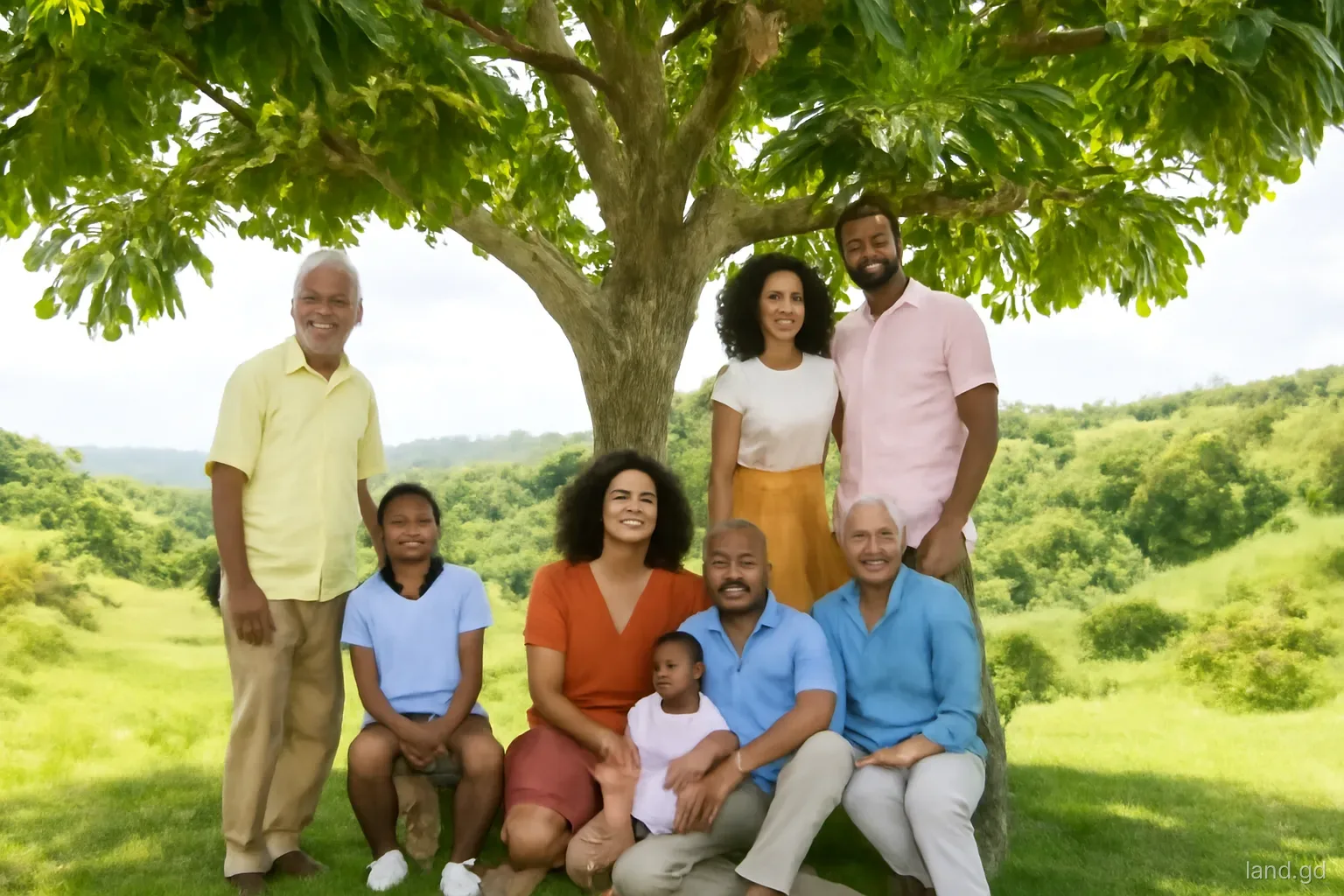
In almost every Grenadian village there is land described simply as "family land": a hillside where several relatives have houses, a garden plot everyone uses, a house spot that a cousin abroad says is his share. Nobody quite knows who owns what on paper, and for long periods nobody needs to. The land feeds people, keeps them close and anchors relatives overseas to a place they call home.
Family land is also one of the biggest obstacles to building, selling, borrowing and resolving disputes in Grenada and across the Caribbean. This page explains what it is in legal terms, how the number of owners grows, what rights each co-owner has, and how families can bring order to it without destroying what it means to them. Legal points here are general; each family's position should be confirmed with a Grenadian attorney.
What "family land" means legally
There is no single legal definition. In most cases, family land is land held by several people as co-owners, usually because an ancestor died without a will, or left the land to several children together, and the estate was never fully divided. Each heir took an undivided share in the whole parcel, not a separate piece.
Co-owners of this kind are generally tenants in common. Each owns a fractional share, a quarter or a sixteenth for example, and can leave or transfer that share. Nobody owns any particular corner, even if they have lived there for decades. When a co-owner dies, their share passes under their will or by intestacy to their own heirs, which is how the fractions multiply.
On top of the legal structure sits a layer of custom. Families often have understandings about who may build where, who farms which section and who looks after the old house. These arrangements matter socially but are rarely written down, and the law may not recognise them unless they are properly documented.
Rights and limits of each co-owner
Right to use the whole. Each co-owner is generally entitled to possess and use the entire parcel, not just a portion corresponding to their share, but must not exclude the others.
No right to sell the whole alone. One co-owner can deal with their own share but cannot sell, mortgage or lease the whole parcel without the others.
Right to ask for division. A co-owner can usually ask the court to divide the land or order a sale if agreement cannot be reached, a remedy covered in more detail in disputes about partition.
Sharing income and costs. Where land produces rent or crops, questions arise about sharing income and the costs of taxes, repairs and improvements. The law has rules, but agreement is far better.
Long occupation by one relative. Where one relative has lived on and controlled family land for many years, questions about their rights can arise. These are difficult and highly fact-dependent.
Why the problems surface
Family land works when nobody needs to prove ownership. The difficulties come with a particular trigger. A relative wants a mortgage to build and the bank asks for clear title. A developer offers to buy the hillside and needs every owner to sign. A cousin returns from abroad, wants to build on "his" part and finds someone else's house already there. Or the government needs part of the land for a road and must decide whom to compensate.
In each case the family discovers that the deed is in a great-grandparent's name, that several generations of estates were never administered, and that there may be dozens of people with a share, some of whom have never set foot in Grenada.
The longer this goes on, the harder and costlier it becomes to fix. Each death without a will adds more heirs, more documents to find and more signatures to collect.
Banks are usually the first to say no. A lender needs to know that the borrower can give a valid mortgage over identified land, and an undivided share in a parcel owned with dozens of relatives rarely satisfies that test.
Putting family land in order: a practical sequence
Families who have done this successfully tend to work through similar stages:
- Find the paperwork: deeds, any survey plans, death and birth certificates, and wills, however old.
- Build a family tree from the registered owner down to living heirs, noting who has died with or without a will.
- Hold a family meeting, including relatives abroad by video call, to explain the situation and agree goals.
- Instruct a Grenadian attorney to advise on which estates must be administered and in what order.
- Commission a survey of the land as it is used today, showing houses, farms and access.
- Agree a plan: keep the land together under a structure, divide it, or sell part and share proceeds.
- Carry out the legal steps: grants, transfers, subdivision approval if needed and registration.
- Encourage everyone who ends up with land to make a will so the problem does not recur.
Ways to hold family land together
Not every family wants to divide its land. Some want the old house and the hillside to remain shared, as a base for gatherings and a link for the diaspora. That can be done, but it works better with structure than with goodwill alone.
Options include a written co-ownership agreement setting out who may use which areas, how costs are shared and how decisions are made; putting the land into a trust with trustees managing it for the family; or transferring it to a family company in which relatives hold shares. Each has costs, tax implications and formalities, and some may affect whether an overseas relative needs a licence to hold an interest.
Whatever the structure, clarity on three questions prevents most fights: who may build, who pays taxes and upkeep, and what happens when someone wants to leave. An attorney can draft the structure; the family has to agree the answers.
Family land and the diaspora
Relatives overseas are often the largest group of co-owners in a family land situation. Generations of migration to Britain, the United States, Canada and Trinidad mean that many heirs have never lived in Grenada, while some who left decades ago still think of a particular house spot as theirs. Their attachment is real, and so are their legal rights.
Including them early makes everything easier. A short written summary of the family tree, the deeds and the options, shared before a family meeting, lets overseas relatives understand what is being proposed and ask questions. Video calls allow them to take part in decisions. Where signatures are needed, an attorney can arrange for documents to be signed before notaries abroad.
Some overseas relatives are happy to transfer or sell their share to those at home, especially when the share is small and the alternative is years of uncertainty. Others want to keep a stake for sentimental reasons. A structure that lets them keep a share without blocking development by those living on the land, or a fair buy-out based on a proper valuation, often resolves the tension.
Mistakes families make with family land
The first is treating long silence as agreement. A relative abroad who has said nothing for twenty years may still own a share and may object when a sale is proposed.
The second is allowing one relative to "handle it" without transparency. Even well-meaning managers attract suspicion if they collect rent or negotiate with buyers without accounting to the others.
The third is starting legal action as a first step. Court proceedings over family land are slow and expensive and rarely heal relationships. Mediation, a family meeting with an attorney present, or a negotiated buy-out often achieves more. Finally, families often underestimate the value of a survey: a plan showing who actually lives where is the basis for almost every solution. Specific legal questions should go to a Grenadian attorney.
Frequently asked questions
What is family land in Grenada?
It usually means land owned by several relatives together, often because an ancestor died without a will or left land to several children jointly. Each holds an undivided share of the whole parcel rather than a defined piece.
Can you build a house on family land?
Many people do, but without the agreement of the other co-owners recorded in writing, and ideally a legal division, the house may legally sit on land you share with others. Get consent documented before building.
Can family land be sold if one relative refuses?
Not easily by private agreement. Where co-owners cannot agree, the court can usually be asked to divide the land or order a sale. This is slow and costly, so negotiation and mediation are worth trying first.
Do relatives abroad still own a share of family land?
If they inherited a share, living abroad does not end it. Overseas heirs have the same rights as those in Grenada and are usually needed to sign any sale, transfer or division of the land.
How can a family stop family land problems growing?
Administer estates promptly after deaths, survey the land, agree in writing how it will be used or divided, and make sure everyone with a share makes a will. Each of these limits the multiplication of owners.