On most of mainland Grenada the rains come from roughly June to December and ease off from January, leaving a dry season that runs into May. In the wet interior around Grand Etang that dry spell is softened by frequent showers. In the south of St George, much of St David's coast, and above all in Carriacou and Petite Martinique, it can mean months of hot, rainless weather, cracked ground and wilting crops.
For a farmer, the dry season is both a problem and an opportunity. Vegetables grown in those months face fewer fungal diseases and often fetch better prices, because supply drops. But they need water, and water is the resource most Grenadian farms are short of exactly when it matters.
This article looks at the practical options for securing farm water, how to choose between them, and how to plan planting around the calendar so the land works for more of the year.
Know your rainfall before you plan
Rainfall in Grenada changes dramatically over short distances. The central mountains catch moisture from the trade winds and receive several times more rain than the low-lying south-western peninsula around Point Salines, which is among the driest parts of the mainland. The east coast of St Andrew and St Patrick is generally wetter than the south coast. Carriacou, low and without high mountains, is markedly drier than the main island and relies heavily on rainwater stored in cisterns.
Before deciding what to grow or how much storage to build, find out what the land actually receives. Local farmers and the Ministry of Agriculture extension office for the district are the best sources. Pay attention to how reliable the rain is as well as how much falls in total: a parcel that gets plenty of rain in the wet months but almost none from February to April needs a very different plan from one with showers spread through the year.
The Grenada Meteorological Service, based at Maurice Bishop International Airport, issues forecasts and seasonal outlooks. Drought warnings in some years give farmers time to cut back planting or arrange water.
The main sources of farm water
Rainwater from roofs. Every roof on the farm, including sheds and animal pens, can feed tanks. Gutters, a first-flush diverter to discard dirty water, and plastic or concrete tanks are a standard Grenadian set-up. A modest roof collects a surprising amount in a heavy shower.
Ponds and catchments. On suitable soils, an excavated pond lined with clay or a membrane can store wet-season run-off for dry-season use. Siting matters: ponds need a catchment, safe overflow and soils that hold water. Large earthworks may need approval, so ask the Physical Planning Unit.
Streams, rivers and springs. Many farms on the mainland sit near watercourses. Taking water from them can affect neighbours downstream and public supply, and abstraction may be regulated. Ask the Ministry of Agriculture and your attorney before installing pumps or pipes.
Piped supply from NAWASA. The National Water and Sewerage Authority supplies piped water to most settled areas. Using treated water for irrigation is expensive at scale, and supply can be restricted in droughts, so it suits small gardens and nurseries better than fields.
Wells. Groundwater use is less common on the mainland than in some islands. Where wells exist, salinity near the coast is a risk. Seek advice before drilling.
Making each gallon go further
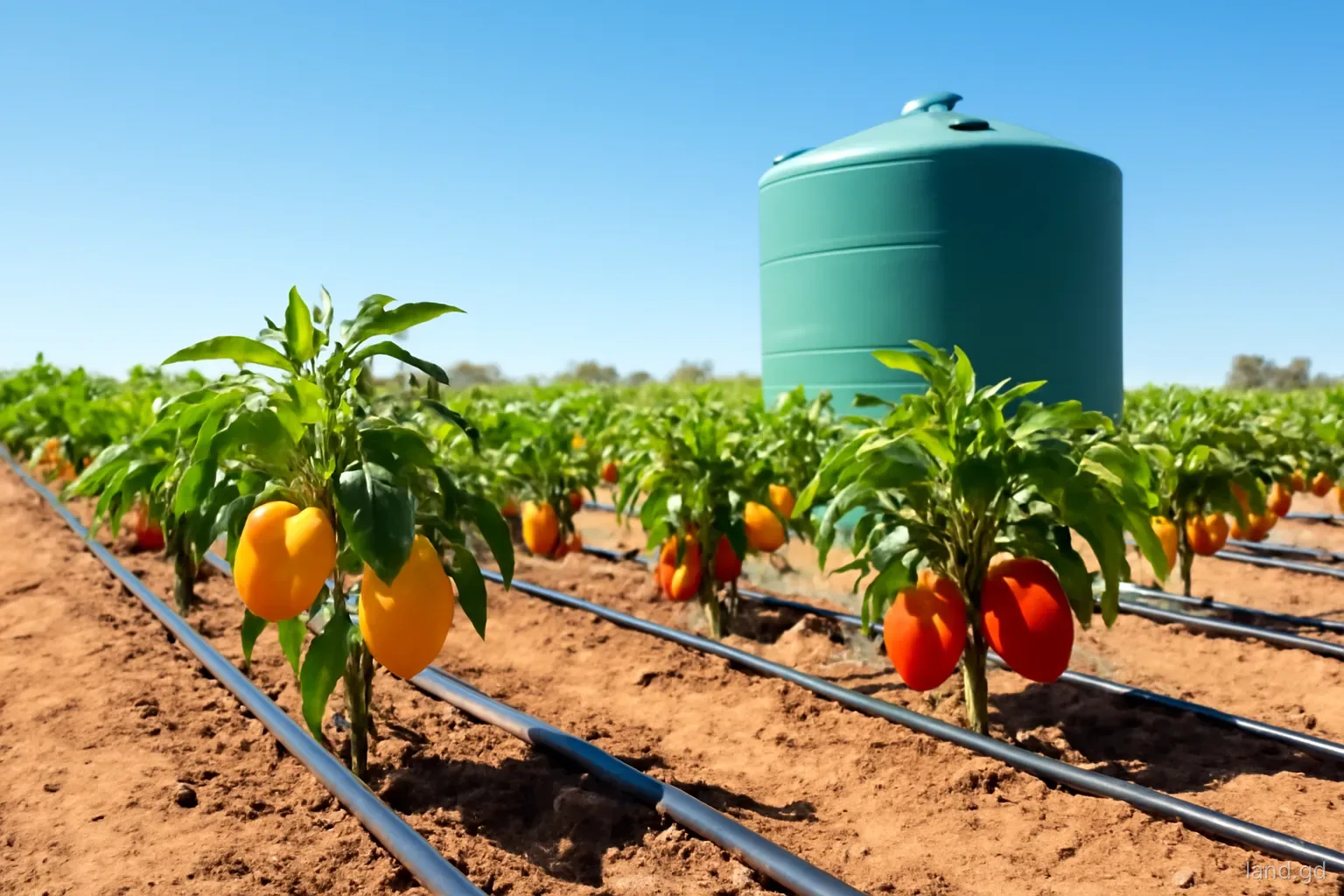
Storage is only half of the answer. How water is applied matters as much as how much is stored. Drip irrigation, which delivers water through thin tubes directly to each plant, uses far less water than sprinklers or hose watering and keeps leaves dry, which reduces disease. Simple gravity-fed drip systems run from a raised tank need no pump at all and suit small vegetable plots well.
Mulch is the cheapest water saver available. A thick layer of cut grass, dried leaves, coconut fronds or other organic material around plants reduces evaporation, keeps roots cool and suppresses weeds. On sloping land, contour beds and planting pits hold rainwater where it falls instead of letting it run off.
Timing helps too. Watering early in the morning or late in the afternoon loses less to evaporation than watering at midday. Grouping crops with similar water needs means the system can be run efficiently, rather than soaking drought-tolerant plants to keep thirsty ones alive.
Shade houses and windbreaks lower the drying effect of sun and wind on young plants, and are covered in more detail in the vegetable guide on this site.
Sizing storage with simple arithmetic
A useful rule of thumb: one inch of rain falling on 1,000 square feet of roof yields roughly 620 US gallons, or about 520 imperial gallons, before losses to gutters, splashing and first-flush diversion. Measure the roof area you can connect, look at how much rain usually falls in the last months of the wet season, and you have a realistic idea of how much a tank system can collect before the dry spell begins.
Then compare that with demand. A vegetable plot on drip irrigation may need a few hundred gallons a week in the hottest months, depending on crop, soil and plot size; ask an extension officer for typical figures. If storage falls short, the choice is to add tanks, add roof area with a simple collection shed, reduce the planted area or switch to hardier crops.
Tanks are sold by hardware and agricultural suppliers in sizes from a few hundred gallons upward. Prices change, so get current quotes, and remember to budget for gutters, piping, a solid level base and, if needed, a small pump. Several connected tanks offer flexibility: one can be cleaned or repaired while the others keep working.
Planning a dry-season crop
A simple planning sequence keeps a dry-season plot within its water budget:
- Estimate how much water you can store or reliably draw at the end of the rainy season.
- Work out roughly how much a crop needs per week with drip irrigation; extension officers can give typical figures for common vegetables.
- Size the planted area to the water you have, with a safety margin for an unusually long drought.
- Plant early in the dry season so crops mature before storage runs low in April and May.
- Choose crops and varieties suited to heat and short water supply: sweet peppers, hot peppers, okra, pumpkin, pigeon peas and some herbs cope better than lettuce or cabbage.
- Check tanks weekly and cut back watering on mature crops first.
Water mistakes that cost a season
Most dry-season failures come from a small number of avoidable errors, and nearly all of them are decided in December or January rather than in April:
- Planting a large area in January with storage that lasts only a few weeks.
- Running overhead sprinklers in the heat of the day, losing much of the water to evaporation.
- Building a pond on porous soil where it never holds water.
- Leaving tanks uncovered, which invites mosquitoes and algae. Mosquito control matters for dengue prevention as well as for water quality.
- Pumping from a stream without checking rights or the effect on neighbours.
- Forgetting hurricane season. Tanks must be secured, because empty plastic tanks blow away in strong winds.
- Neglecting gutters and filters, so the first big shower of the rainy season is lost or fills the tank with debris.
Carriacou and Petite Martinique: farming with very little rain
On Carriacou and Petite Martinique, water is the defining constraint for farming and household life alike. Most homes rely on rain collected from roofs into cisterns, and agriculture has historically centred on livestock such as goats, sheep and cattle, and on drought-tolerant crops like pigeon peas and corn planted with the rains. Pigeon peas and corn are closely tied to island traditions, including the planting season and the Maroon festival held to pray for rain.
Irrigated vegetable growing on these islands needs serious storage and careful use. Some farms combine large roof catchments with drip systems and shade structures. Hurricane Beryl in July 2024 damaged many buildings, roofs and tanks on both islands, so anyone planning a farm there should check the current condition of water infrastructure and the availability of materials before committing.
Frequently asked questions
When is the dry season in Grenada?
The dry season generally runs from about January to May, with the rainy season from June to December. Timing and severity vary from year to year and across the islands, with the south of the mainland and Carriacou drier than the mountainous interior. Local farmers and the Meteorological Service give the best guide for a given area.
Can farmers use stream water for irrigation?
Many do, but taking water from streams and rivers can affect neighbours and public water supplies, and may be subject to rules or permissions. Ask the Ministry of Agriculture and an attorney before installing pumps or diverting a watercourse, and avoid taking so much that flow downstream suffers.
Is drip irrigation worth it on a small Grenada plot?
For most vegetable plots it is. Drip systems use much less water than sprinklers, keep leaves dry and can be gravity-fed from a raised tank without a pump. The initial cost is modest compared with losing a dry-season crop, and kits and parts are sold by agricultural suppliers.
Which crops cope best with dry conditions?
Pigeon peas, okra, pumpkin, sweet potato, cassava, hot peppers and some herbs tolerate dry spells better than leafy greens. Lettuce, cabbage and tomatoes need regular water. Matching crops to available water is the simplest way to avoid losses in the dry months.
How should water tanks be prepared for hurricane season?
Secure tanks with straps or a solid base so they cannot blow away, keep lids fastened, and clear gutters. A full tank is heavier and more stable than an empty one, which is one reason many households keep storage topped up during the season from June to November.