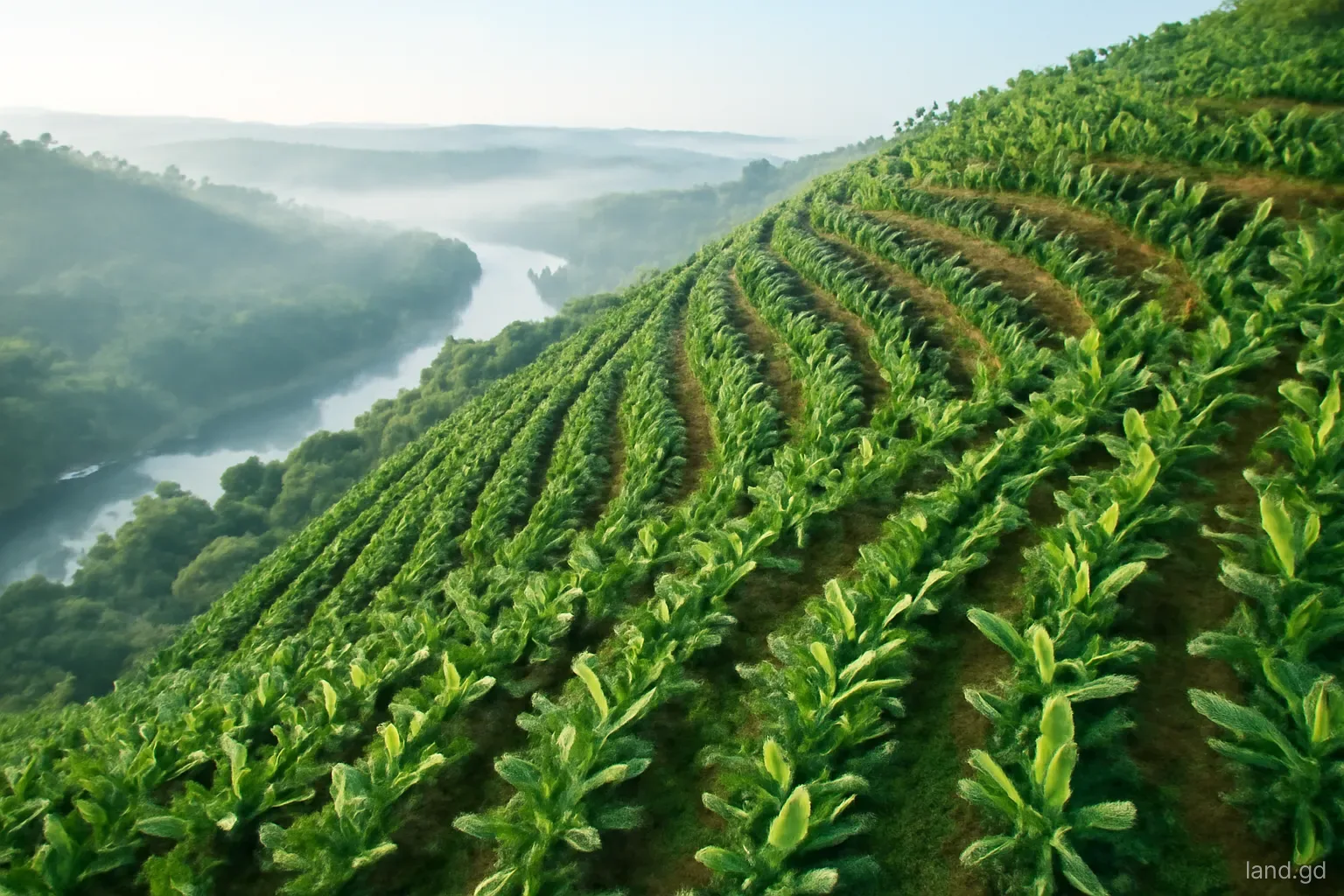
Grenada's mainland is volcanic in origin, and the soils that formed on its old lava and ash are, in the wetter areas, among the most productive in the Eastern Caribbean. They are also often on slopes that would make a farmer from a flat country nervous. Much of the island's best agricultural land sits on hillsides above narrow river valleys, from the Gouyave and Grenville watersheds to the steep country of St Mark.
Farming that land well is a balance. Clear a slope too hard and the topsoil built up over centuries can wash into the nearest river in a few heavy rainy seasons. Leave it under a mixed canopy of tree crops and it can stay productive for generations. This article explains the soils, the risks and the techniques that let hillside land keep its value.
Where Grenada's soils came from
The island was built by volcanic activity over millions of years, and its landscape still shows old craters and crater lakes such as Grand Etang and Lake Antoine. Weathering of volcanic rock under a warm, wet climate produced deep soils in much of the interior and on the wetter slopes, generally with good structure and drainage when they are well managed.
Soils vary with rainfall, slope and parent material. In the wet central uplands they tend to be deep, porous and rich in organic matter under forest and tree crops, though heavy rainfall leaches nutrients over time. In drier areas such as the south of St George and St David, soils are often heavier and more clay-rich, crack in the dry season and become sticky when wet. Valley bottoms collect deposited soil and can be very fertile, but they may flood. Carriacou has its own geology, with older volcanic and sedimentary rocks, and generally thinner soils under a much drier climate.
Grenada's soils were surveyed and classified in the twentieth century, and the Ministry of Agriculture can advise on the general soil type in a district. That information is a starting point; what matters most is the soil on your particular slope.
Testing what you actually have
A few simple checks tell a farmer more than any general map of the island:
- Dig several holes to at least the depth of a spade and a half, in different parts of the parcel, and look at how deep the dark topsoil goes.
- Squeeze a handful of moist soil. Sticky soil that holds a ribbon is clay-rich; gritty soil that falls apart is sandy or stony.
- Pour a bucket of water into a hole and watch how fast it drains. Very slow drainage suggests waterlogging problems.
- Look for earthworms, roots and dark organic matter, all signs of healthy soil life.
- Note stones and rock close to the surface, which limit root depth.
- For fertiliser decisions, take samples to a soil-testing service; the Ministry of Agriculture can advise on where tests are done and how to sample correctly.
Why erosion is the biggest threat
Rain in Grenada often falls in intense bursts, especially in the rainy season and during tropical storms. On bare, cleared slopes those downpours detach soil particles and carry them away in sheets and gullies. The topsoil, which holds most of the nutrients and organic matter, goes first. What is left is harder, less fertile and drains worse, so the next storm runs off faster still.
The damage does not stop at the farm boundary. Soil washed off hillsides muddies rivers, blocks drains and culverts, settles in coastal waters and smothers coral reefs and seagrass. Landslides on over-cleared or badly cut slopes have damaged roads and homes in several parishes over the years.
Common causes are well known: clearing slopes completely for annual crops, burning bush before planting, ploughing or forking up and down the slope, cutting roads and tracks without drainage, and letting goats and cattle overgraze steep pasture. Each is avoidable.
Techniques that keep hillsides productive
Contour planting. Lay out beds, rows and tree lines across the slope, following the contour, so each row acts as a small barrier to run-off. A simple A-frame level made from three sticks and a weight is enough to mark contours.
Grass and hedge barriers. Strips of vetiver grass or hedges planted along the contour trap soil, gradually building natural terraces. Vetiver is widely used in the Caribbean for this purpose.
Terraces and bench beds. On steeper intensive plots, terraces or bench beds create level growing surfaces. They take labour to build and need drainage to stop water breaking over the edges.
Permanent cover. Keep the ground covered with crops, mulch or cover plants. Avoid leaving soil bare through the rainy season.
No burning. Fire destroys organic matter and leaves soil exposed. Cut and leave bush as mulch instead.
Drains and waterways. Divert water from tracks and buildings into grassed channels that carry it safely downhill.
Tree crops as a hillside farming system
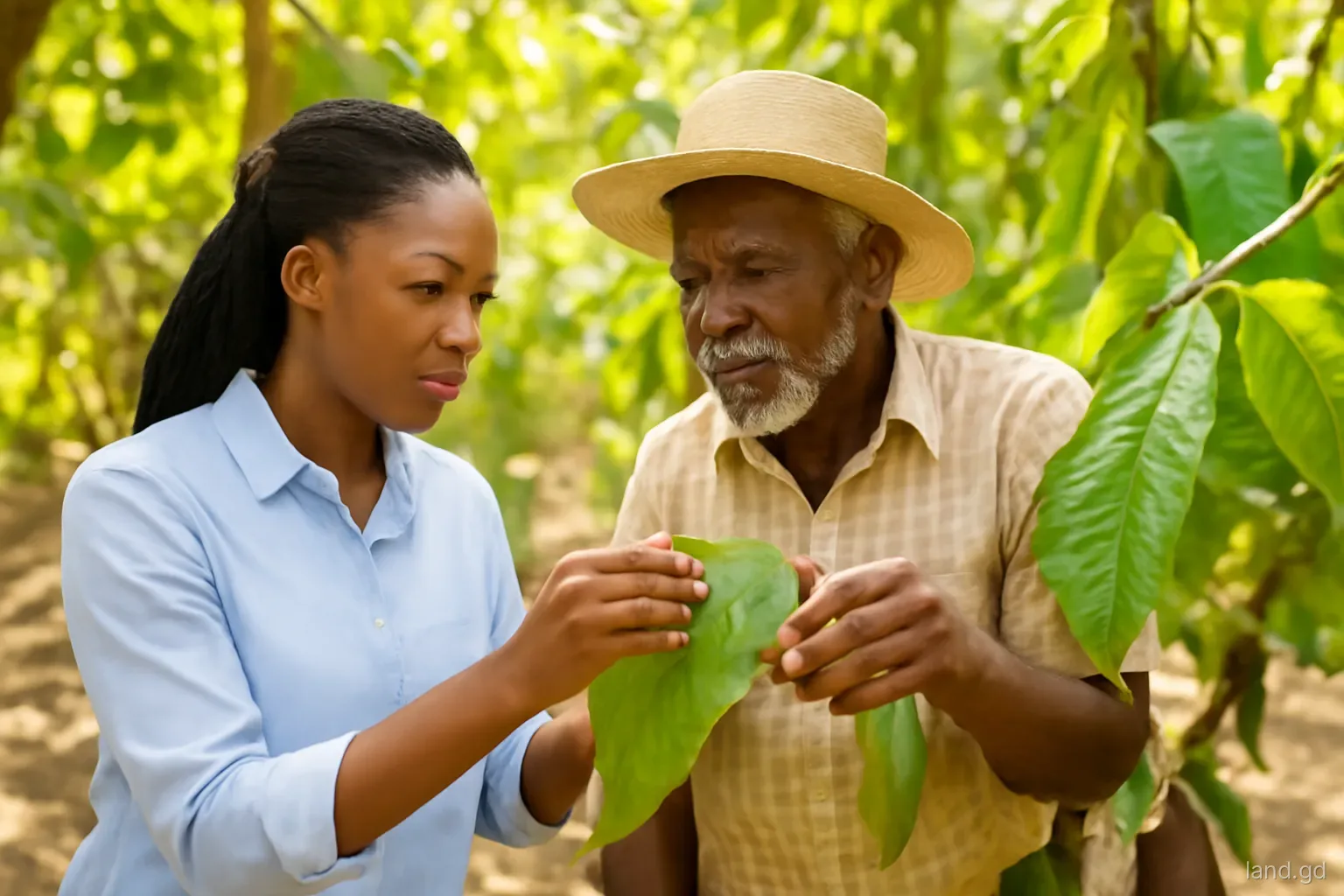
The traditional Grenadian farm on steep land is effectively an agroforest: nutmeg, cocoa, bananas, breadfruit, mango, avocado, citrus and shade trees growing together in layers, with ground provisions in gaps. This system holds soil remarkably well, because roots bind it and the canopy breaks the force of falling rain, while leaf litter builds organic matter year after year.
For buyers of hillside land, this is a strong argument for keeping or restoring tree crops on the steepest ground and reserving gentler slopes, bench terraces and flat valley areas for vegetables and other annual crops. It also makes the land more resilient to hurricanes than a single crop. Ivan and Beryl both showed that mixed farms recovered faster than monocultures, because not every species was flattened.
Where forest remains on very steep slopes, ridges, gullies and stream banks, leave it. Those areas protect water supplies and are often subject to forestry rules; the Forestry Department can advise on what may and may not be cleared.
Livestock on steep land
Goats, sheep and cattle are part of many Grenadian smallholdings, and on Carriacou they are central to farming. On slopes they need careful management. Animals tethered or grazing in the same spot for too long strip vegetation, compact soil and wear paths that become gullies in the first heavy rain. Free-roaming goats are a frequent cause of disputes between neighbours, because they eat young trees and vegetables.
Rotating grazing areas, keeping stocking levels modest and moving tethered animals regularly allow grass to recover. Cut-and-carry feeding, where fodder such as grass, gliricidia and other leafy shrubs is cut and brought to penned animals, protects slopes and makes it easier to collect manure for crops. Fodder hedges planted along the contour do double duty as soil barriers.
Fencing is costly on rough ground, but even partial fencing of tree-crop blocks and vegetable areas prevents a great deal of damage. Ask the Ministry of Agriculture's livestock staff about suitable breeds, fodder plants and animal health, and check with the Physical Planning Unit before building permanent pens close to boundaries or watercourses.
Keeping soil fertile over time
Good soil management is a habit rather than a single fix, built season by season. The basics on Grenadian hillsides include:
- Returning crop residues, prunings and husks to the field as mulch or compost.
- Adding manure from goats, sheep, poultry or cattle, well rotted before use on vegetables.
- Planting legumes such as pigeon peas and beans, which add nitrogen.
- Rotating annual crops so pests and nutrient demands do not build up in one spot.
- Using fertiliser according to soil tests rather than habit, to save money and avoid run-off into streams.
- Liming acid soils only when tests show it is needed.
- Keeping a record of what was planted where and what was applied, so the next decision rests on facts rather than memory.
Frequently asked questions
Is Grenada's soil good for farming?
Much of it is, particularly the deep volcanic soils in the wetter interior and on many hillsides, which suit tree crops and a wide range of food crops. Soils in drier areas tend to be heavier and less forgiving, and steep slopes limit what can be grown without erosion. Local conditions vary greatly.
Where can soil be tested in Grenada?
The Ministry of Agriculture can advise on soil-testing services available on the island and on how to take samples correctly. Extension officers can also help interpret results and recommend fertiliser and lime. Arrangements change, so ask the district extension office for current options.
How steep is too steep to farm?
There is no single rule, but very steep land is difficult to work safely, erodes rapidly when cleared and is better kept under permanent tree crops or forest. Moderate slopes can be farmed with contour planting, barriers and terraces. Seek advice from an extension officer for a particular site.
What is vetiver grass used for?
Vetiver is a deep-rooted clump grass planted in strips along the contour to slow run-off and trap soil. Over time the strips build small natural terraces. It is widely used in the Caribbean for slope stabilisation on farms, roadsides and drainage channels.
Why is burning bush discouraged before planting?
Burning destroys organic matter, kills soil life and leaves the ground bare and exposed to heavy rain, which speeds erosion. In the dry season it can also spread to neighbouring farms and forest. Cutting bush and leaving it as mulch protects and feeds the soil instead.