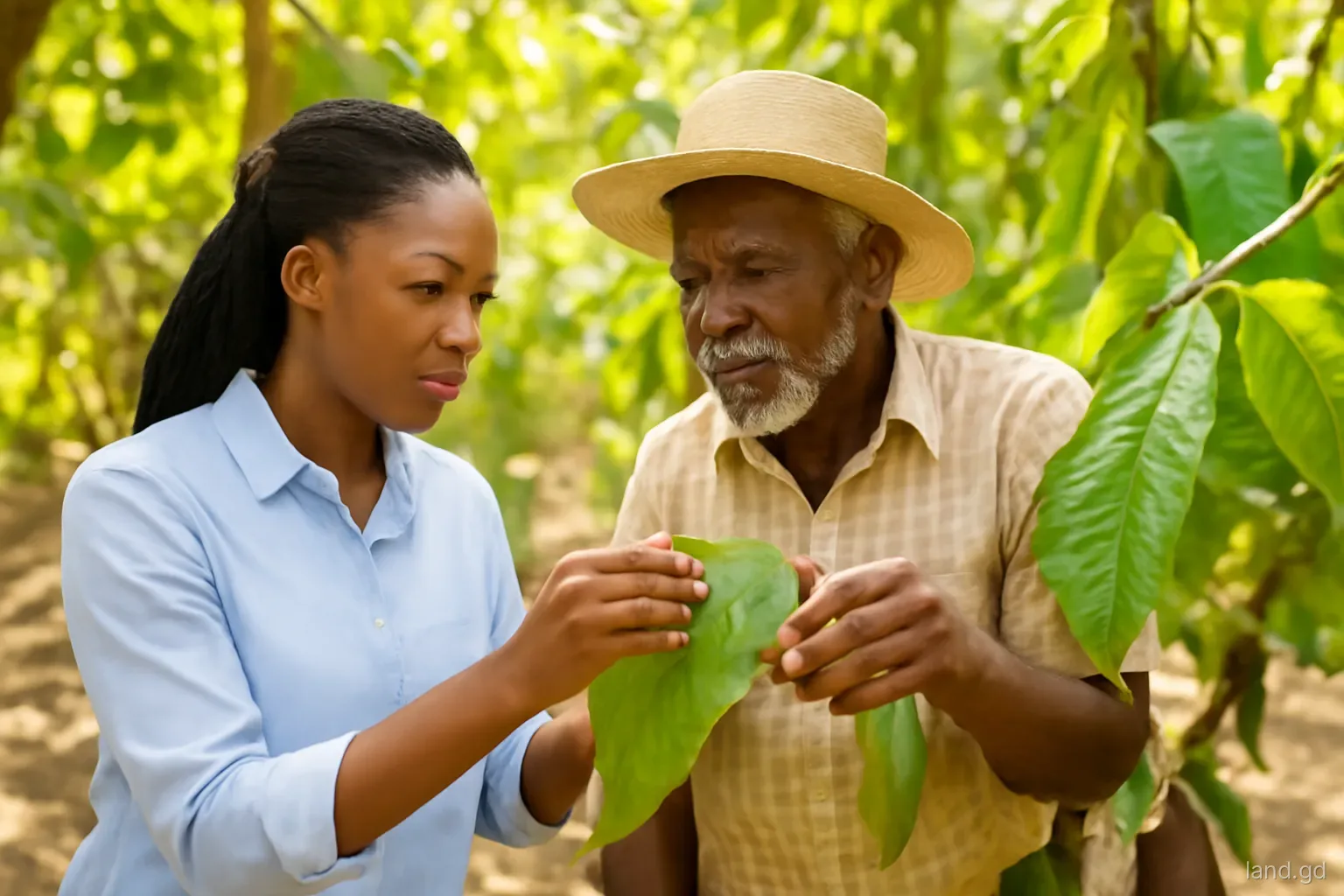
A new farmer in Grenada soon discovers that a lot of help exists, but it is spread across many bodies, and knowing which door to knock on saves weeks. Advice comes mainly from the Ministry of Agriculture's extension service. Marketing for the export crops runs through long-established associations. Credit, inputs, training and research involve other agencies again, some of them regional.
This guide sets out who does what, in plain terms, so that a farmer or landowner can find the right starting point. Names of ministries and programmes change with governments and over time, so treat it as a map and confirm current details with each body.
The Ministry of Agriculture and its extension service
The Ministry of Agriculture, whose full title has varied to include lands, forestry and fisheries in different periods, is the central government body for farming. For most farmers its most useful face is the extension service: officers based in agricultural districts around the island who visit farms, diagnose pest and disease problems, advise on crops and techniques, and pass on information about government programmes.
Building a relationship with the extension officer for your district is one of the best early investments a new farmer can make. They know local soils, rainfall, pests and which farmers nearby are doing well. They can also tell you about propagation stations, which raise planting material such as nutmeg, cocoa, fruit trees and vegetable seedlings, and about any support schemes running at the time, for example after a hurricane or drought.
The ministry also handles plant and animal health, including quarantine rules on importing plants, seeds and animals, which exist to keep out pests and diseases that are not yet present. Anyone thinking of bringing in planting material from abroad should ask the ministry first.
The commodity associations
Grenada Co-operative Nutmeg Association. The GCNA, established in 1947, receives nutmeg and mace from growers, processes it at its stations, including the well-known one in Gouyave, and markets it abroad. Growers are paid in stages, typically an advance at delivery and later payments depending on sales. Registration and delivery arrangements should be confirmed with the association.
Grenada Cocoa Association. The GCA has historically bought cocoa from farmers and handled fermentation, drying and export. Its role has evolved as local chocolate makers have become buyers in their own right, so ask about current purchasing arrangements.
Other co-operatives and farmer groups. Farmers' organisations, women's groups and village co-operatives exist in many parishes, some focused on a crop such as bananas or vegetables, others on shared marketing or inputs. They vary in how active they are, and an extension officer will know which are working in your area.
Selling produce: MNIB and other channels
The Marketing and National Importing Board, the MNIB, is a state body that buys local fruit, vegetables and other produce and sells them through its own outlets and to institutions such as schools and hotels. It also has a role in importing certain goods. For small farmers it can be a useful buyer, especially for produce in steady demand, though prices, quality standards and payment terms should be discussed before you plant.
Beyond the MNIB, farmers sell through public markets, supermarkets, hotels and restaurants, agro-processors making sauces, juices, jams and spice products, and direct sales to households. Exports of fresh produce to neighbouring islands, particularly through traders who ship to Trinidad and other markets, have a long history, but involve plant health certification and should be arranged with care.
The more outlets a farm can supply, the less exposed it is to any single buyer's decisions.
Credit, insurance and finance
Farming needs money before it makes money. The main sources of agricultural finance and risk management include the following, though products and terms change:
- The Grenada Development Bank, a state development finance institution that has offered loans for agriculture and agro-processing. Ask about current products, eligibility and the security required.
- Commercial banks and credit unions, which lend to farmers with a track record, collateral and a clear plan. Credit unions in particular are rooted in parish communities and may know local farmers well.
- Government grant or input programmes, often announced after disasters or as part of food security drives, providing seedlings, fertiliser, tools or small grants.
- Insurance for crops and structures, which is limited and can be expensive; ask brokers and the ministry what is available.
- Registration as a farmer with the Ministry of Agriculture, which may be required for some benefits or duty concessions on agricultural inputs. Ask what documents are needed.
Regional and international partners
Several regional and international bodies work with Grenadian agriculture. The Caribbean Agricultural Research and Development Institute, CARDI, carries out research and development on crops and livestock across the region and has a presence in Grenada. The Inter-American Institute for Cooperation on Agriculture, IICA, and the United Nations Food and Agriculture Organization, FAO, support projects on food security, climate resilience and farmer training.
Bilateral technical assistance from various countries has, over the years, funded demonstration farms, shade houses, irrigation and training. Programmes come and go, so ask the ministry what is current.
Training is also offered locally. T. A. Marryshow Community College has run agriculture programmes, and the ministry, farmer organisations and project partners hold workshops on topics such as protected agriculture, pest management, livestock and agro-processing. These sessions are often free or low cost and are a good way to meet other farmers.
Support after hurricanes and droughts
Grenada's agriculture has been reshaped by disasters more than once. Hurricane Janet in 1955 and Hurricane Ivan in 2004 both devastated tree crops on the mainland, and Hurricane Beryl in July 2024 struck Carriacou and Petite Martinique hardest while also damaging farms in the north of the main island. Droughts in some years have hit vegetable and livestock farmers.
After major events, the government and international partners have usually run recovery programmes: distributing planting material, tools, fertiliser, livestock feed or cash grants, and clearing fallen trees. Farmers who are already registered with the Ministry of Agriculture, and who can show what they had before the event, are generally best placed to receive help quickly. That is one more practical reason to register, keep records and photograph the farm from time to time.
The National Disaster Management Agency, NaDMA, leads overall preparedness and response. For farm-specific losses, report damage to the extension office as soon as it is safe, since damage assessments are often used to plan assistance.
A newcomer's first moves
Someone starting to farm in Grenada can use this support structure most effectively by moving in a clear order:
- Contact the Ministry of Agriculture and find out who the extension officer for your district is.
- Ask about farmer registration and what documents are needed, such as proof of ownership or a written lease.
- Visit the nearest propagation station to learn what planting material is available and when.
- If growing nutmeg or cocoa, speak to the relevant association about registration and delivery.
- Talk to potential buyers, including the MNIB, before planting large areas of vegetables.
- Approach the Grenada Development Bank, a credit union or a bank only once you have a written plan and costings.
- Join a farmers' group or attend training to build local contacts.
Pitfalls when seeking support
A few misunderstandings regularly frustrate new farmers, and most of them can be avoided with a little preparation before the first visit to any office:
- Expecting support without registration or paperwork. Many programmes require proof of land tenure.
- Relying on one-off grants instead of building a farm that pays its way.
- Importing planting material without checking quarantine rules, risking pests and confiscation.
- Planting a crop because a programme supplies free seedlings, without a buyer lined up.
- Not keeping receipts and records, which lenders and programmes ask for.
- Applying for a loan with no costings, then being turned away and concluding that credit is closed to farmers. Lenders respond to plans they can read.
- Expecting an extension officer to visit at short notice in the busiest weeks after a storm. Officers cover large districts, so book visits early and be specific about the problem.
- Assuming a programme announced on radio or social media is still open; always confirm dates and eligibility with the office running it.
Frequently asked questions
How can a farmer contact an extension officer in Grenada?
Contact the Ministry of Agriculture and ask for the extension officer covering your area; officers are organised by agricultural district. They can visit farms, diagnose problems and explain current programmes. Building that relationship early is one of the most practical steps a new farmer can take.
Do farmers need to register with the Ministry of Agriculture?
Registration is not needed simply to grow food, but it may be required to access certain support programmes, duty concessions on inputs or post-disaster assistance. Ask the ministry what registration involves and which documents, such as a deed or written lease, are needed.
What does the MNIB do for farmers?
The Marketing and National Importing Board is a state body that buys local produce and sells it through its outlets and to institutions. It can be a useful outlet for small farmers, particularly for crops in steady demand. Discuss prices, quality and payment arrangements before planting with the MNIB in mind.
Can farmers get loans for agriculture in Grenada?
Yes. The Grenada Development Bank has offered agricultural finance, and commercial banks and credit unions also lend to farmers with a sound plan and security. Terms change, so ask each lender directly about current products, interest rates and requirements before preparing an application.
Can plants or seeds be brought into Grenada from abroad?
Importing plants, seeds and animals is regulated to keep out pests and diseases, and permits or inspections may be required. Bringing in material without checking can lead to confiscation and risks harming local agriculture. Ask the Ministry of Agriculture's plant protection and quarantine staff before importing anything.