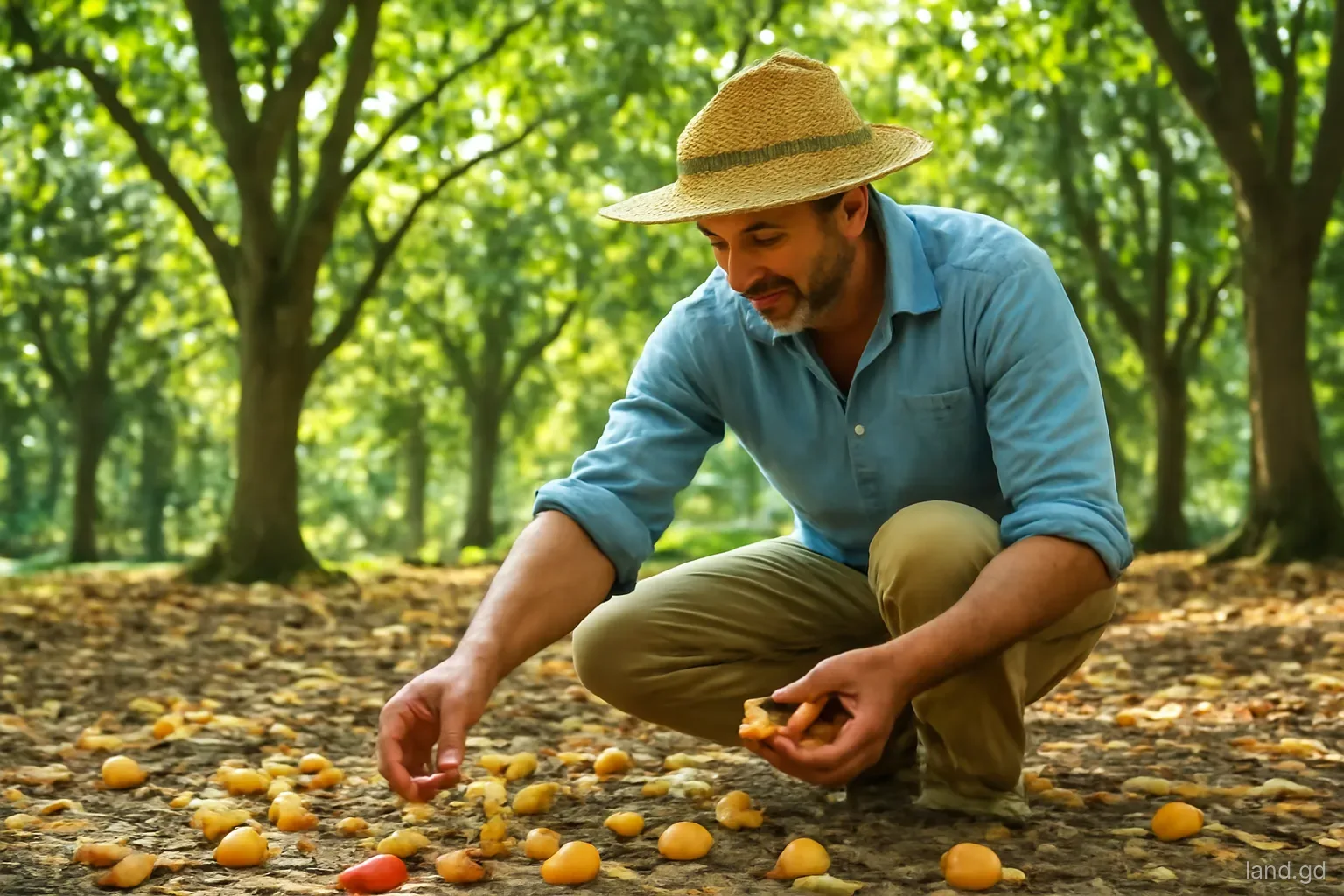
Nutmeg is the crop on Grenada's flag and the one most outsiders associate with the island, yet very few people who buy a hillside in St John or St Andrew understand how slowly a nutmeg orchard comes into its own. A tree planted this year may not tell you whether it is male or female for five years or more, and it will not reach full bearing for well over a decade.
That timescale shapes every decision: what planting material to buy, how to space the trees, what to grow between them while you wait, and how to sell the crop once it arrives. It also explains why Hurricane Ivan in September 2004 hurt the industry so badly. Orchards that took a generation to build were flattened in an afternoon, and replanted trees have only gradually come back into production.
This article walks through the practical side of growing nutmeg on Grenadian land, for a new farm or for an inherited block of old trees that needs reviving.
The male and female problem
The nutmeg tree, Myristica fragrans, normally carries male and female flowers on separate trees. Only female trees produce fruit. A seedling raised from a nut gives no reliable clue to its sex until it flowers, which usually takes somewhere between five and eight years in Grenadian conditions. Historically about half of seedlings turned out male, and a farmer who planted nuts could find that a large share of a block was never going to bear.
Farmers dealt with this in two ways. The traditional approach was to plant closely, wait for flowering and then cut out most of the males, keeping a small proportion as pollinators scattered through the field. The more modern approach is to plant vegetatively propagated material taken from known female trees, by grafting or by rooting cuttings and layers, so that the sex is known from the start.
Ask any supplier exactly what you are buying. A grafted plant from a proven female tree costs more than a seedling and may be harder to find, but it saves years. Ask whether some male plants are included or recommended, because a block with no males at all can suffer poor pollination. The Ministry of Agriculture's propagation stations and extension officers are the first people to ask about availability, since supply of improved planting material has varied over the years.
Choosing where nutmeg will thrive
Rainfall. Nutmeg does best in the wetter parts of the island, where rain is spread through much of the year. The traditional heartland runs through the hills of St John, St Mark, St Andrew and St Patrick and the central parishes around the mountain range. The drier south of St George and St David, and most of Carriacou, are marginal without irrigation.
Soil and drainage. Deep, well-drained volcanic soils rich in organic matter suit the tree. Waterlogged hollows cause root problems, so avoid low spots where water sits after rain.
Shelter. Nutmeg is shallow-rooted for its height and brittle in strong winds. Valleys and leeward slopes protected from the prevailing easterlies lose fewer trees in storms than exposed ridges.
Shade when young. Young plants prefer partial shade. Bananas, plantains and other temporary crops between rows provide it while also producing income.
Access. Nuts are gathered from the ground and carried out in bags. A steep plot without a track to the road turns every harvest into heavy lifting.
Establishing a new block
A sensible planting programme on bare or cleared land usually follows this order:
- Clear selectively. Keep useful shade and boundary trees and avoid stripping a slope bare before the rains, which invites erosion.
- Mark out planting holes along the contour on sloping ground. Spacing guidance varies, so take the current recommendation from an extension officer; wider spacing suits grafted material, which does not need thinning.
- Plant early in the rainy season, typically from June onward, so roots establish before the dry months of the following year.
- Set temporary shade and intercrops: bananas, plantains, root crops or pigeon peas between the rows.
- Mulch around each young tree and weed by hand or with a cutlass rather than burning, which damages shallow roots.
- Replace failures in the first two seasons so the stand stays even.
- Once trees flower, identify sex if seedlings were used, and thin males to the recommended proportion.
Harvest, nutmeg and mace
A mature nutmeg fruit looks rather like an apricot. When ripe it splits open, showing the dark brown seed wrapped in a bright red lacy covering, the mace. Fruit falls naturally, and in most Grenadian farms the crop is collected from the ground every few days rather than picked from the tree. Trees bear through much of the year, with heavier periods that vary by location.
At collection the outer pericarp is discarded or used for products such as nutmeg jam and syrup, and the mace is peeled off carefully by hand. Mace is worth more per pound than the nut, so it pays to remove it cleanly in large pieces. The green nut in its shell is then delivered for drying and processing.
Old trees can bear for decades. If you inherit an orchard, a period of clearing vines, pruning dead wood and opening the canopy often brings a noticeable improvement before any replanting is needed.
Selling the crop through the co-operative
For most of the twentieth century, nutmeg and mace in Grenada have been marketed through the Grenada Co-operative Nutmeg Association, the GCNA, established in 1947. Growers deliver to the association's receiving points, and the nuts go to processing stations, best known at Gouyave and Grenville, where they are dried, cracked, graded and packed for export. The station at Gouyave is also visited by tourists who want to see the sorting process.
Payment has traditionally come in two parts: an advance per pound at delivery, and a later surplus payment depending on the year's sales. How that works in practice, including registration requirements and current delivery points, should be confirmed directly with the association, because arrangements have changed as the industry recovered from Hurricane Ivan and as world prices moved.
Some growers also sell small quantities to local processors, spice vendors and agro-processing businesses making oils, syrups and cosmetics. That can earn a better price for small volumes, but it rarely replaces the association for a farm of any size.
Intercrops that carry the waiting years
Because a nutmeg block earns almost nothing for its first several years, most Grenadian growers plant other crops between the rows. Bananas and plantains are the classic choice: they give the young trees the partial shade they want, produce within a year and can be thinned as the nutmeg canopy closes. Root crops such as dasheen, tannia and sweet potato make use of open ground in the first seasons, and pigeon peas fix nitrogen while giving a dry-season harvest.
Longer-lived companions are also common. Cocoa is often grown with nutmeg in the wetter valleys, and fruit trees such as breadfruit, mango, avocado and soursop are planted along boundaries and in gaps. A mixed farm of this kind spreads risk: if one crop has a poor year or prices fall, the others continue, and a storm rarely damages every species equally.
Plan intercrops so they do not compete too hard. Keep vigorous crops a reasonable distance from young nutmeg stems, do not let vines climb the trees, and reduce the intercrop as the orchard grows. By the time the nutmeg trees are well established, the field should be moving towards a shaded tree-crop system that needs less weeding.
Mistakes new nutmeg growers make
Nutmeg forgives a lot, but a few errors cost years. The most frequent are worth listing:
- Buying unlabelled seedlings and discovering, years later, that most of the field is male.
- Planting on an exposed ridge because the view is good. The trees will be the first to fall in a storm.
- Leaving young trees without shade in the first dry season.
- Expecting income too soon. A business plan for a nutmeg farm needs intercrops and other tree crops to carry the early years.
- Ignoring theft. Praedial larceny is a real issue in rural Grenada; a farm far from any house is harder to protect, and growers should keep records of what they deliver.
- Clearing an inherited block with fire. Burning damages roots and soil and can spread to neighbours' land in the dry season.
Frequently asked questions
How long before a nutmeg tree produces in Grenada?
A young tree usually starts flowering and bearing a little fruit after about five to eight years, and production builds slowly after that. Grafted material from proven female trees can come into bearing somewhat earlier and removes the uncertainty about sex, though full production still takes many years.
Can nutmeg be grown in Carriacou?
Carriacou is much drier than the mainland and has long dry seasons, which makes commercial nutmeg difficult without reliable irrigation. A few trees in a sheltered, watered garden may survive, but the island's farming has historically centred on hardier crops and livestock rather than spices.
Do growers have to sell nutmeg to the GCNA?
Most commercial growers sell through the Grenada Co-operative Nutmeg Association because it handles processing and export. Small quantities can be sold locally to processors and vendors. Rules and arrangements can change, so confirm current requirements with the association and the Ministry of Agriculture before planning your sales.
Why is mace separated from the nutmeg?
Mace is the red lacy covering around the seed and is sold as a separate spice, usually at a higher price per pound than the nut. Removing it carefully in large pieces at collection, and keeping it clean and dry, protects its value when it is delivered.
How did Hurricane Ivan affect nutmeg farms?
Hurricane Ivan in September 2004, followed by Hurricane Emily in 2005, destroyed or damaged a large share of the island's nutmeg trees. Because the crop takes years to mature, production fell sharply and recovery depended on replanting, which is why many orchards today are younger than they look.