
Walk or drive through rural Grenada and old stonework appears everywhere once you start looking: a round tower half-hidden by trees, an arch carrying nothing across a gully, a line of brick fireplaces in a roofless shell, a massive cast-iron wheel rusting in a field. These are the remains of the estates that dominated the island for two centuries.
Most of them are not signposted or interpreted. Learning to read them turns a drive into a history lesson and, for landowners, helps them understand and protect what sits on their own property. This field guide explains the main types of structure and the clues that identify them, from sugar works to cocoa houses.
Start with the works yard
On a sugar estate the heart of production was the works yard, a cluster of buildings arranged to move cane quickly from the fields to the mill and juice from the mill to the boiling pans. The layout typically followed a logic that can still be read in the ruins: a mill on higher ground or beside a water source, with the boiling house close by and slightly lower, so that juice could flow by gravity, and then curing and distilling buildings beyond.
Do not expect neat ruins. Many works yards were altered repeatedly, as estates changed from animal power to wind or water, replaced machinery, added steam engines in some cases, or reused buildings for cocoa or storage after sugar ended. Walls may have been robbed for stone, and vegetation can hide entire buildings. Reading a site is often a matter of piecing together fragments.
Finding the mill is usually the key to understanding the rest. Once you have identified how cane was crushed, look for the channels, gutters or remains of pipes that carried juice away, and for the long building with fireplaces that marks the boiling house.
Cocoa and nutmeg estates had a different arrangement, centred on fermentation, drying and storage rather than crushing and boiling. Many estates switched from sugar to cocoa in the nineteenth century, so their ruins may combine both: an old sugar mill beside a newer cocoa drying house.
Three kinds of mill
Animal mills. The earliest and simplest mills were turned by cattle, mules or horses walking in a circle. Their remains are a raised circular platform or a ring of stone, often on a slight rise, with traces of the central pivot where the rollers stood.
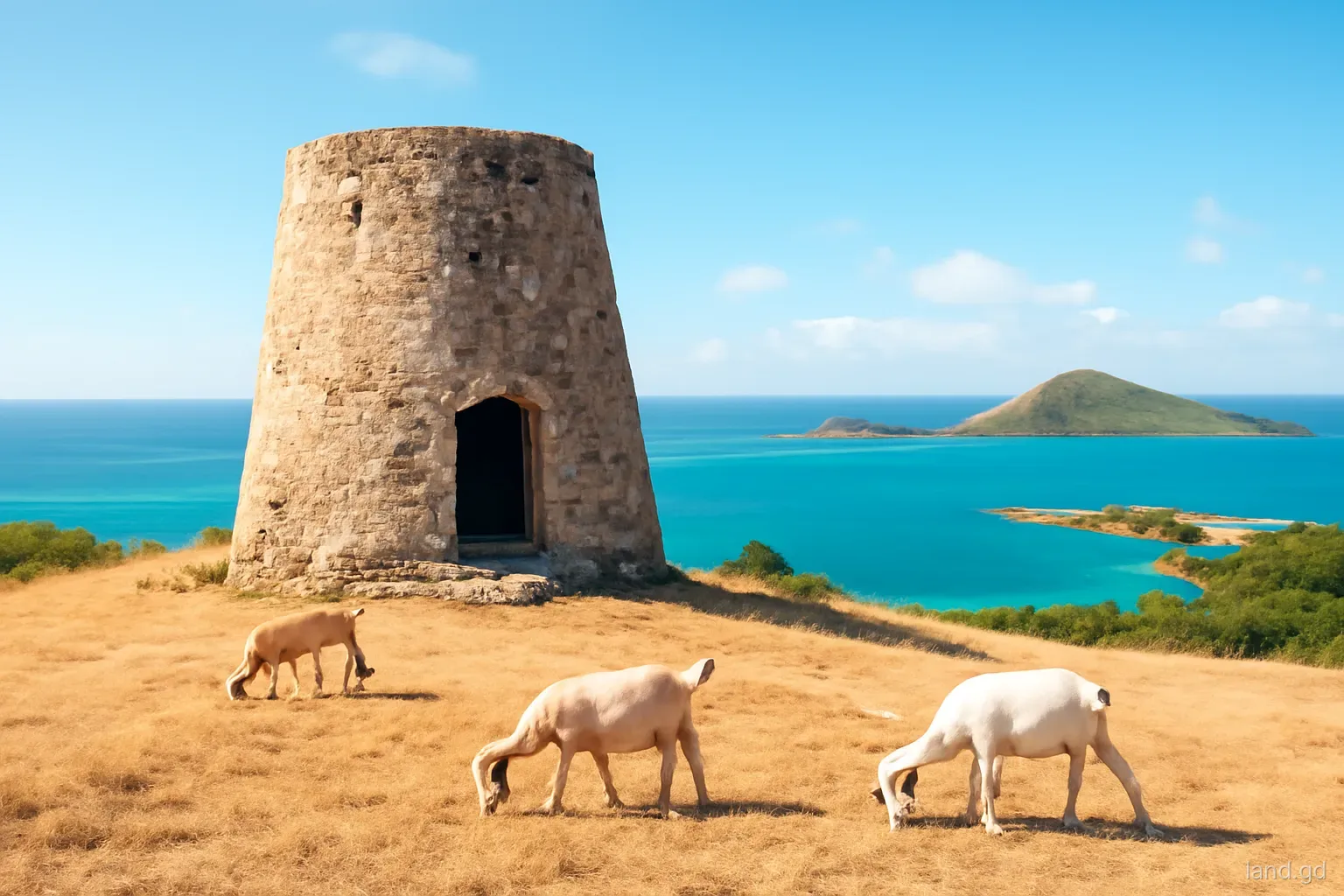
Windmills. Round, tapering stone towers, usually on exposed ridges or hilltops to catch the trade winds, with arched openings at the base. The wooden sails and machinery have long gone. Windmill towers are a feature of drier, windier areas, including parts of Carriacou and the south and east of the mainland.
Water mills. Where streams allowed, a water wheel drove the rollers. Look for a wheel pit, a stone-lined slot beside the mill building, and an aqueduct or channel bringing water from upstream. River Antoine in St Patrick still runs on this principle and shows how such a mill worked.
Aqueducts, channels and water
Water mills needed a steady supply delivered at height, which led to some of the most elegant estate structures: stone aqueducts carried on arches across valleys and gullies, and long channels contouring along hillsides for considerable distances. An isolated arch or a line of stone piers crossing a stream often marks a former aqueduct whose mill has disappeared.
Estates also needed water for people, animals and processing. Look for cisterns, often rectangular or round stone tanks with plastered interiors, sometimes underground; wells; and channels leading from roofs. In Carriacou, where rain is scarce, cisterns were and remain essential.
For landowners, these features have a practical side. Old channels may still carry water in heavy rain and influence drainage on today's land. Cisterns and wells, often hidden by vegetation, are a serious hazard and should be located and covered safely.
Inside the boiling house and beyond
The buildings downstream of the mill each left recognisable traces:
- Boiling house: a long building, often with a row of brick or stone fireplaces or flues along one side, where a series of copper pans of decreasing size, the "coppers", boiled the juice down. Rings of masonry where coppers sat are a clear clue.
- Chimney: a tall stone or brick stack attached to the boiling house, sometimes surviving long after the building has fallen.
- Curing house: a building where sugar was left to drain molasses, sometimes with sloping floors or channels.
- Still house: where molasses and skimmings were fermented and distilled into rum; look for remains of fermenting cisterns and the base of a still.
- Machinery: cast-iron rollers, gears, flywheels and pans, often made in Britain, sometimes lie abandoned nearby; some carry foundry marks that help date them.
Cocoa houses, boucans and spice drying
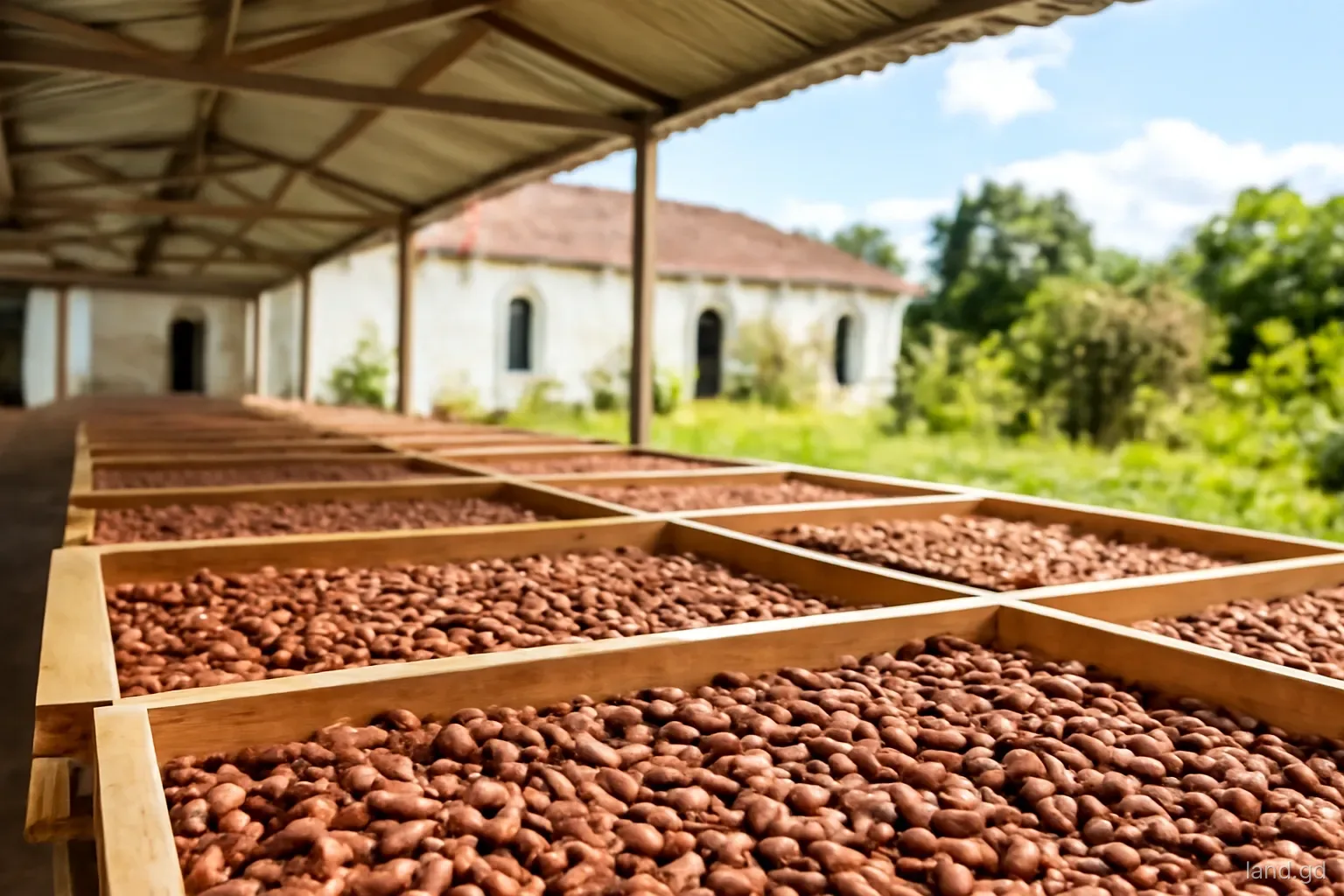
The most distinctive structures of Grenada's cocoa estates are the drying houses, often called boucans locally. Fermented cocoa beans were dried in the sun on large wooden trays, and to protect them from sudden rain the trays ran on rails so they could be rolled under a roof, or the roof itself slid on rails over fixed trays. Belmont Estate in St Patrick still uses this traditional system, which makes it easy to recognise the remains elsewhere: parallel rails, long low platforms and sheds with an open side.
Fermentation took place in wooden boxes or sweat boxes, usually in a building close to the drying area. On spice estates, nutmeg and mace were dried on racks in buildings designed for airflow, sometimes on upper floors over stores.
Look also for small square or rectangular buildings near the drying area with thick walls and few openings. These were often stores where dry beans and spices waited for shipment, kept secure against theft and damp, and some still carry iron bars or heavy doors.
Because cocoa and nutmeg remained important into the twentieth century, these buildings are often in better condition than the older sugar works, and some are still used or adapted.
Great houses, villages and burial grounds
The great house was usually placed on a rise above the works, catching the breeze and commanding a view of the fields. Its ruins are often the most substantial: thick stone walls, cellars or ground-floor stores, staircases and sometimes the outline of verandahs. Nearby may be an overseer's house, kitchen buildings set apart because of fire risk, and stables.
The houses of the enslaved and later the labourers were usually built of less durable materials and have left far fewer traces. Their villages may show only as level platforms, scattered stones, fruit trees planted long ago or fragments of pottery. These sites are historically important precisely because so little was recorded about the people who lived there.
Burial grounds, both for estate owners and for enslaved people and labourers, exist on some estates. They deserve particular respect, and any disturbance during clearing or building should stop and be reported.
Exploring and protecting ruins responsibly
Estate ruins are fragile, often dangerous and nearly always on private land. Many have survived two centuries of storms only to be damaged by careless clearing or souvenir hunting in a single afternoon. A few rules protect both visitors and the sites:
- Ask the landowner's permission before entering, and respect a refusal.
- Stay clear of leaning walls, unstable arches and the edges of wheel pits, wells and cisterns.
- Watch for wasp nests, which are common in old stonework, and wear sturdy footwear.
- Do not climb on walls or remove stones, bricks, tiles, pottery or metalwork.
- Photograph and note what you find; local heritage bodies such as the Grenada National Trust may be interested in records of little-known sites.
- If you own land with ruins, avoid bulldozing or burning around them, and seek advice before restoring or building nearby.
Frequently asked questions
What are the round stone towers seen in Grenada and Carriacou?
Most are the remains of windmills used to crush sugar cane on colonial estates. They stand on exposed hilltops and ridges where the trade winds blew strongly. The wooden sails and machinery have gone, leaving tapering stone towers with arched openings at the base.
What is a boucan in Grenada?
Boucan is the local name for a cocoa drying house, where fermented beans dry in the sun on wooden trays. The trays or the roof run on rails, so the beans can be covered quickly when rain comes. Belmont Estate in St Patrick still uses this traditional design.
Can a landowner keep machinery or artefacts found on the land?
Old machinery and artefacts are part of Grenada's heritage even when on private land. Before moving, selling or scrapping anything significant, contact the Grenada National Trust or the national museum for advice, and report archaeological finds made during building or clearing rather than removing them.
Are estate ruins dangerous?
They can be. Walls may lean or collapse, arches can be unstable, and old wells, cisterns and wheel pits are often hidden under vegetation. Wasps nest in stonework. Visit only with permission, keep away from unstable structures and take particular care with children.
How can the age of an estate ruin be worked out?
Clues include building style, materials, the type of mill, and foundry marks on any cast-iron machinery. Old deeds, maps held in archives and published histories can help. Local historians and heritage bodies may already know the site, so asking them is a good first step.